The Long Walk Home
A guide to Berlin's underground techno — Tresor to Berghain, RSO to the Renate lease fight. The rooms, the door, the philosophy. From NOA.
By NOA
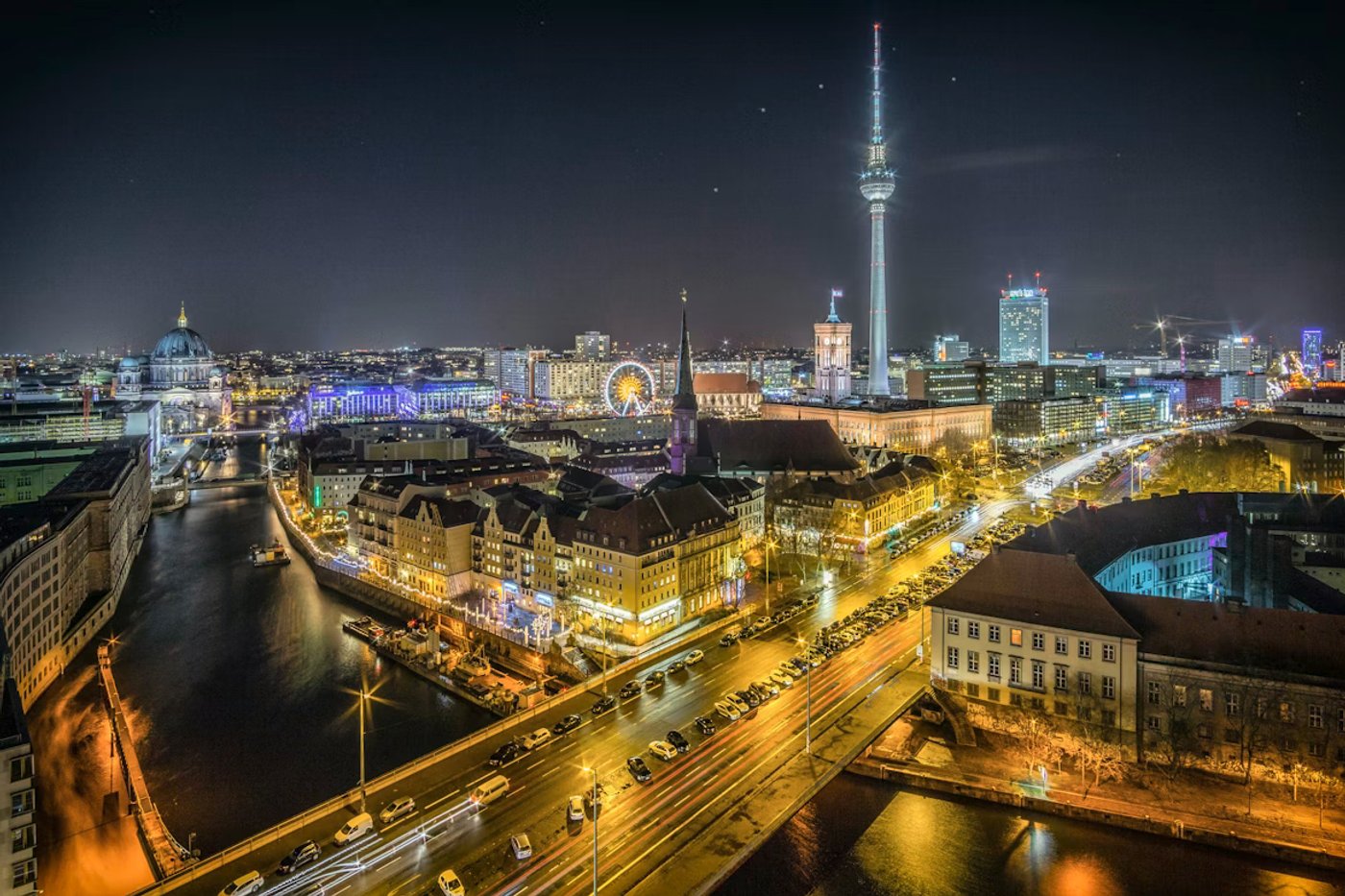
Berlin techno was never about the music. Not at the start.
When the Wall came down, the empty buildings did too. Vaults, power stations, train depots, bunkers — the east side of the city sat there stunned, without function, without purpose. And the kids filled them with sound.
Tresor opened inside a department store safe in 1991. Dimitri Hegemann, who'd been running UFO Club in the west, walked into the basement of the old Wertheim on Leipziger Straße and saw a literal bank vault. He put a PA system inside it and pressed play on a Detroit techno record. The origin lives there. Berlin techno started as reconstruction work, not entertainment — a way to put empty spaces back into use.
This guide is for people who already know some of this and want the rest. The rooms worth knowing. The door policy as philosophy. The lineages from Basic Channel to what happens on a courtyard dance floor in Neukölln tonight. And why, after three decades and a global pandemic and rising rents and a government that keeps almost killing the nightlife, the city still has a dance floor to defend.
Reconstruction, not entertainment
To understand why Berlin techno became the thing it became, you have to understand what the city was in 1990.
Reunification left East Berlin with thousands of vacant industrial spaces, no functioning police presence in the east for months, and a generation of young people who'd grown up on either side of a wall that had just come down. The squat movement absorbed some of the vacancies. The DIY culture absorbed another slice. And the sound systems — some imported from Detroit, some built by hand out of whatever parts were around — claimed the rest.
The 4/4 kick drum as a heartbeat for a city that had nearly died. That's not a metaphor. That's the actual physiological function of the early Berlin techno dance floor — a city using a 120 BPM pulse to convince itself it was still alive.
This is why Berlin techno, to this day, is more austere than techno anywhere else. It doesn't perform. It doesn't build up and drop. It doesn't signal. The residents at the canonical rooms play marathon sets — eight, ten, twelve hours — because the music is a room condition, not a show. The DJ is a barometer, not a star.
The Detroit connection matters. Jeff Mills), Juan Atkins, and Derrick May) all came through Tresor repeatedly through the 90s, and what they were doing with 909 drum machines in motor-city basements translated almost without friction into the post-Wall vaults. Then Berlin took the sound and mutated it. Basic Channel — the project of Moritz von Oswald and Mark Ernestus — dubbed it out, stretched it, added reverb and delay until techno became a kind of dub music with a kick drum. That lineage — dub techno, Rhythm & Sound, the Chain Reaction catalogue — is the sound that a lot of other Berlin rooms still play today when nobody's trying to dance.
The Door
The most-repeated thing anyone says about Berlin nightlife is the door policy. It's the punch line of a thousand travel blogs, the content of every Berghain parody video, the reason most first-time visitors feel either liberated or humiliated.
Most of the writing about it gets it wrong.
The Türsteher — the bouncer — is not a gatekeeper. He's a priest. His job is not to keep the wrong people out. His job is to keep the room sacred. Those are different things. A gatekeeper enforces a rule. A priest is custodian of a condition.
The condition is: the room has to stay honest. No cameras. No content creation. No groups of twelve. No bottle service. No VIP. No table. The person next to you at the bar could be a techno producer, a plumber, a lawyer on a four-day weekend, a nineteen-year-old on their first night out, or Ben Klock going to see what somebody else is playing. The flattening of hierarchy is the entire point. If you showed up hoping to be seen, you are now a threat to the condition. The Türsteher declines you not out of taste but out of fidelity to the room behind him.
The no-phone rule follows from the same logic. Phones break the condition. You can't be fully present and also documenting. You can't be dancing and also editing. Berghain's sticker over the camera is not a gimmick; it's a ritual. You surrender the lens at the door the way you surrender shoes at a temple.
Some of this sounds precious when you write it out. Standing in the queue at six in the morning in January, waiting for a bouncer to look at you and make a decision you don't get to argue with, you feel it differently. The queue is part of the architecture. Whether or not you get in is not the most interesting question.
The canonical rooms
Berghain in Friedrichshain is the former Heizkraftwerk — a GDR-era power station — that opened in 2004 and became what it became by accident, or at least by a slow accumulation of taste. The main floor is cavernous, concrete, lit as little as possible. Panorama Bar upstairs is the house room, lower ceiling, more warmth. The Säule annex runs experimental and ambient programming. Residents include Marcel Dettmann, Ben Klock, Norman Nodge, Boris — and the residents are the thing. Guest bookings are selective. Sets run long. Weekend programming starts Saturday night and doesn't end until Monday morning.
Tresor in Mitte, rebuilt inside Kraftwerk at Köpenicker Straße, is the origin. The old vault is gone; the new one is in the basement of another former power station. Still running. Still platforming uncompromising artists — Regis, Paula Temple, UVB, Aïsha Devi through the experimental lens. The sound system in the basement vault is one of the physically most intense in Europe. Tuesday and Saturday nights are the nights to know.
://about blank in Friedrichshain is collective-run, left-political, explicitly anti-commercial. Two dance floors plus a garden. More eclectic than the capital-letter clubs — you'll get a techno night, a leftfield night, a Gqom night, a queer party, and a political benefit all in the same weekend. Strong stance on door diversity.
OHM in Mitte sits in the old battery room of Tresor's building. Small. Experimental. Ambient, minimal, leftfield techno. The room where you go to listen, not to lose yourself. Sunday daytime programming is where the listening culture is most concentrated.
RSO (full name Revier Südost) in Schöneweide opened 2021, run by the team behind Griessmühle, the beloved Neukölln club that closed in 2020. Multi-room, housed in a former brewery, equipped with a custom-engineered Kirsch sound system, and quickly established as one of the city's most serious programming venues. Recent lineups have stretched across Kobosil, I Hate Models, Charlie Sparks, Daria Kolosova — which tells you where Berlin's hard-techno axis sits in 2026.
Kater Blau on the Mitte/Kreuzberg border, riverside, was rebranded simply as Kater in 2024. More melodic, more colorful, more experimental than the industrial-canonical clubs — Kater has always leaned into tribal, tropical, weird-jazz-that-still-dances programming. The open-air garden is the thing in summer. Thursday through Sunday.
Renate in Friedrichshain is multi-room, maximalist, painted-on-the-walls Berlin weirdness inside a converted apartment block on Alt-Stralau. In August 2024 it announced it would close at the end of 2025 because the lease wasn't being renewed. It threw an eighty-six-hour farewell across New Year's Eve 2025 into the small hours of January 2026. Then, days before that goodbye, the landlord and the club reached a new rental agreement and the closure was reversed. The club is currently dark while it resets — bookings paused, organisational rebuild, reopening date held back. The full state of things is: Renate fought for its lease and won, and the doors are not open yet, and that's the truth of where the Berlin nightlife crisis sits in April 2026.
Sisyphos is the surreal one — three dance floors, a cinema tent, a fake pirate ship, weekends that run from Friday to Monday. Weekender energy. Less heavy than the Berghain / RSO axis but canonically Berlin.
The refusal to close
The Clubcommission's most recent figure landed like a cold front. Roughly forty-six percent of surveyed Berlin clubs were considering permanent closure within two years. Over a hundred clubs have shut down since the early 2000s — to rising commercial rents, residential development, post-pandemic attendance drops, and a generational shift toward festivals and daytime events. The A100 motorway extension is a concrete one-sentence way to put the threat: a stretch of road being pushed east through Friedrichshain that would, if completed in the form planned, cost the neighbourhood several of its most important rooms.
Watergate closed on New Year's Eve 2024, after twenty-two years of goodbye parties facing the Spree from the Oberbaumbrücke. Griessmühle closed in 2020 — its team rebuilt as RSO, which is the happier half of that story. Mensch Meier in Prenzlauer Berg shut permanently. SchwuZ, Berlin's oldest queer club at fifty years, filed for bankruptcy in August 2025. The Clubcommission's public framing is honest about the structural problem: Berlin's clubs have always operated on temporary leases in buildings that could be turned into apartments, offices, or hotels the minute the landlord runs the numbers.
The counter-story is the one that matters. Renate fought for its lease and won the argument, even if the doors are still shut while the team resets. RSO has become, in five years, one of the two or three most important programming venues in the city. The Berghain-Panorama Bar-Säule complex keeps booking new residents. The experimental scene — OHM, Säule Sundays, courtyard parties in Kreuzberg and Neukölln, ://about blank's garden through the open-air season — is arguably in better shape now than it was pre-pandemic.
The tension is real. The outcome is not predetermined. Every weekend someone makes the choice to go out to a room with concrete walls and no cell service, and that's the vote that keeps the lights on.
The sound itself
"Berlin techno" is shorthand. There are at least four sounds that co-exist under the label, and a good night in the city usually crosses at least two of them.
The dub axis runs through Basic Channel, Rhythm & Sound, Monolake, and the whole Chain Reaction label lineage. Long tracks. Dub-reggae's reverb and space, translated to a 4/4 pulse. This is the sound of Sunday morning at OHM, or Panorama Bar's late-Sunday-night listening set, or a small party in a Kreuzberg courtyard.
The industrial axis is Marcel Dettmann, Ben Klock, and Regis at Tresor. Harder, faster, more mechanical. Minimal ornamentation. This is Berghain's main floor at 4am and Tresor's vault at 2am.
The hard-techno resurgence runs through FJAAK, VTSS, Charlie Sparks, I Hate Models, and Daria Kolosova. Tempos at 150+ BPM. Gabber-adjacent. Faster than the canonical Berlin sound but programmed in the canonical Berlin rooms, particularly RSO. This is where a significant slice of the 2026 crowd lives, and where a lot of the Spanish, Italian, and Polish dancers have been pulling the city.
The experimental axis is Rrose, Oake, Jonny Nash, the Säule Sunday programming, the ambient-and-listening side of the city. Less dance, more room. OHM, Tempelhof during the open-air season, the semi-secret courtyard events. This is the sound a lot of first-time visitors miss and long-term residents return to.
A city that holds all four of these is a city that actually has a scene. Any of them alone would not be Berlin. The whole thing together is Berlin.
The neighborhoods
Friedrichshain. Post-Wall warehouse conversion. Berghain, Renate, ://about blank. The canonical east-Berlin nightlife geography. Grittier than Mitte, more built-up than Schöneweide.
Kreuzberg. Turkish-punk-squat crossover. The old SO36 punk scene on one side, Gezi-era Turkish political culture on the other, Kater on the river. The neighborhood that has the longest continuous underground culture in the city — went from West Berlin squat scene to post-reunification crossroads without ever really stopping.
Neukölln. The current generation. Cheaper (until recently), dirtier, more experimental. Smaller rooms, courtyard parties, bars that are secretly listening sessions. Hermann's bar, Sameheads, the Griessmühle diaspora now scattered across a dozen smaller spaces. If you want to know what Berlin will sound like in three years, go to Neukölln on a weeknight.
Schöneweide. The industrial edge, far enough southeast that you have to commit to the trip. RSO is there. The breweries, the docklands, the S-Bahn line that makes the commute itself part of the ritual. This is where Berlin's heavy side has moved.
Mitte. Central. Tresor and OHM in the Köpenicker Straße power-station complex. The tourism is here, but so is the history — the Leipziger Straße vault that started everything, the rebuilt vault that carries it now. Mitte's underground is quieter than the outer districts' but older.
What Berlin sounds like right now (April 2026)
The hard-techno wave is still cresting, but the counter-movement is visible. Ambient and experimental programming is increasing. The Sunday daytime slot — OHM's stretch, Säule's regular programming, the Panorama Bar last-hour listening sets — is taken more seriously now than it was three years ago, partly as a response to the BPM arms race at the hard end. The crowd demographic is more international than it's ever been — the Spanish contingent is enormous, the Italians are close behind, and the post-Brexit British weekender has stabilized at a steady level.
The rents keep going up. The rooms keep finding ways to open. The balance is not settled and probably won't be.
Berlin, as NOA Sees It
NOA is built around six cities. Berlin was always going to be one of them.
The Berlin Crew heavy-cotton crewneck carries the city-code embroidery and a line cut into the inside label: heavy cotton, cut for rooms without windows. The Achilles (BE) is a 360gsm straight-leg pant with AFTER and HOURS printed tonal across the lower panels in a near-black-on-black that you can only read if you're close. The 140 (Midnight) corduroy cap fits any of the six cities but was designed in this register.
None of it has a logo on the outside. None of it has branding loud enough to be photographed. The Berlin pieces are cut for the same condition the rooms themselves are built for: you shouldn't be able to tell what you're looking at from far away. You have to be close. That's the whole idea.
The door is the ethos. The room is the point. No assholes. That's the brand, and it's the city.
Next: Lagos. The city exports a generation of music every year. We'll be there.
Cited:
- *Tresor — original site, current Kraftwerk-era programming*
- *Berghain — official, Panorama Bar + Säule programming*
- *://about blank — collective-run Friedrichshain venue*
- *OHM Berlin — battery-room programming, Sunday listening*
- *RSO — Schöneweide programming, post-Griessmühle continuation*
- *Kater Blau / Kater — riverside open-air programming*
- *Renate — current dark-while-resetting status, post-lease-fight*
- *Sisyphos — weekender programming*
- *Watergate — closed NYE 2024 after 22 years*
- *Mensch Meier — closed permanently*
- *SchwuZ — bankruptcy filing 2025*
- *Clubcommission — Berlin club-scene survey + closure data*
- *Basic Channel — Moritz von Oswald and Mark Ernestus, dub techno catalogue*
- *Chain Reaction Music — Basic Channel's sister label*
- *Monolake — Robert Henke project*
- *Oake — experimental Bandcamp catalogue*
- *Resident Advisor artist pages — Marcel Dettmann, Ben Klock, Norman Nodge, Regis, Paula Temple, Aïsha Devi, Kobosil, I Hate Models, Daria Kolosova, FJAAK, VTSS, Rrose*
- *A100 motorway extension — Berlin Senate planning record*
- *Wikipedia: Jeff Mills), Juan Atkins, Derrick May), Moritz von Oswald*